
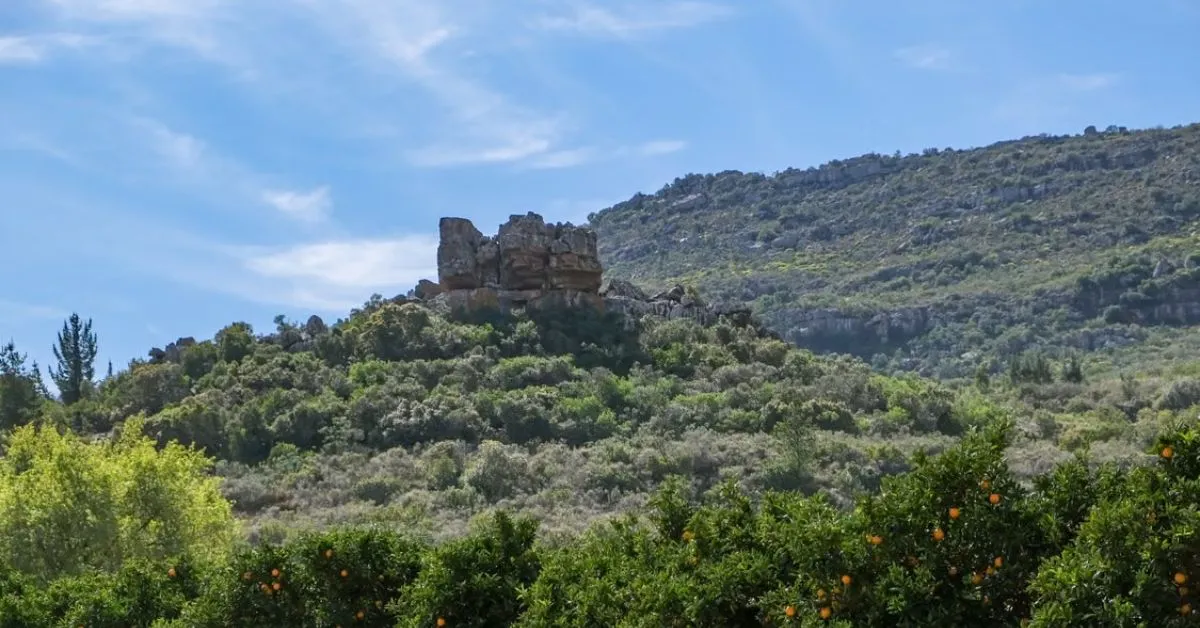
While the rest of the Western Cape shivers, winter in Citrusdal is the prime season for activity. The days are dry, sunny, and often surprisingly warm, while the nights offer a crisp, freezing clarity perfect for wood fires and stargazing. As you descend the Piekenierskloof Pass, the air shifts, often carrying the intoxicating scent of orange blossoms (neroli) during the late winter transition into spring. It is an otherworldly landscape of ancient, fire-red rock formations and rugged peaks, offering a soul-restoring escape into the wild.
The Wolfberg Cracks and Arch
If you only have time for one adventurous trek, the 16km round-trip to the Wolfberg Arch is a non-negotiable Cederberg experience. This hike offers an adventurous feel that is nearly unparalleled in South Africa, taking you from the valley floor into a Martian-like plateau of eroded sandstone.
The journey begins with a steep ascent to the base of a massive cliff band. Here, the trail splits into two distinct routes via the Wolfberg Cracks: the Narrow Crack and the Wide Crack. The Narrow Crack is a playground for the nimble, requiring scrambling through dark chambers and navigating under massive boulders (it is recommended to go up the Narrow and down the Wide). Once you emerge onto the top plateau, the terrain levels out into a stunning, silent landscape that eventually reveals the iconic Wolfberg Arch, a natural monument that stands as the region’s crowning glory.
Logistical note: Before heading to the trailhead, you must obtain a permit and a gate code from the Dwarsrivier (Sanddrif) reception. Access to the parking area is restricted without this code.
Quick stats
- Distance: 16km (round trip)
- Difficulty: Moderate to challenging
- Permits: Required; obtainable from Dwarsrivier (Sanddrif) reception
The Sevilla Rock Art Trail
The Sevilla Rock Art Trail is less of a standard hike and more of a 5km journey through the spiritual history of the Cederberg. This route leads you past nine distinct San rock painting sites, nestled among the rugged terrain along the Brandewyn River.
Winter is the absolute best time to walk this trail; during the peak of summer, the sun is fierce on this exposed path. On a winter morning, you will likely find the nearby Khoisan Kitchen (where you buy your permits) buzzing with young boulderers from the Rocklands area, sipping coffee and making use of the free Wi-Fi between climbs. This social epi-centre adds a vibrant, modern energy to an otherwise ancient landscape.
Pro tip: If you are short on time, walk briskly past the first four sites. Sites 5 through 9 contain some of the most detailed and well-preserved work; spend your time there before visiting the earlier sites on your leisurely return.
Piekenierskloof Mountain Resort Trails
Perched at the top of the pass, the Piekenierskloof Mountain Resort offers a perfect contrast in hiking styles. Below the hotel, families can enjoy flat, kid-friendly paths through reeds and fynbos, where birdlife is prolific.
For those seeking a more rugged experience, the uphill scramble behind the hotel is a local favourite. It is a narrow, 30-minute climb that tests your fitness but rewards you with a 360-degree panorama of the Olifants River Valley and the layered Sneeuberg peaks. For an insider experience, ask the staff about the secret viewing spot on the Paleisheuwel road; they often take guests there for private sunset picnics.
After your descent, a game of giant chess back at the resort serves as the perfect post-climb mental ritual. If you stay late, watch for the long-exposure light trails left by trucks navigating the winding pass below.
A Botanical Wander at Boschkloof Guest Farm
Situated in the Sneeuberg Conservancy, Boschkloof Guest Farm is where lush citrus orchards meet the rugged mountain kloofs. The farm features several trails ranging from leisurely farm tracks to more challenging routes that dig deep into the fynbos-covered slopes.
A highlight for history enthusiasts is the hike to the historic blokhuis (block house), a stone remnant of the Anglo-Boer War. The walk along the farm tracks provides a quiet, contemplative experience of the arid mountain scenery. Winter visitors should keep a sharp eye on the higher elevations; the coldest months see the blooming of the rare, endemic Snow Protea. By August, the farm is transformed as carpets of wildflowers appear and the scent of neroli fills the air. End the day as the locals do, with a slow braai as the sun dips behind the peaks.
Hike and Soak at The Baths Natural Hot Springs
The mountain trails at The Baths balance physical exertion with deep relaxation. Two trails ascend through the rugged natural terrain, offering panoramic views of the valley. These paths are ideal for hikers who want to feel the wilderness without a full-day commitment.
The true magic here is the reward. After a bracing winter walk, there is nothing quite like a healing soak in the 43°C natural thermal waters. Whether you choose the outdoor hot pool or the private Jacuzzis in the Olsen Building, the combination of cold mountain air and mineral-rich water is the ultimate winter luxury.
Essential Winter Hiking Notes
The Cederberg’s semi-desert climate requires specific preparation. While days are pleasant, the drop in temperature after sunset is dramatic.
| Feature | Winter detail (mid-May to August) |
|---|---|
| Day temperature | Cool to quite warm; often sunny |
| Night temperature | Cold to freezing; significant drop at sunset |
| Rainfall | Low (180mm annually); semi-desert conditions |
| Unique flora | Snow Protea (coldest months); neroli (from August) |
| Key gear | Warm jacket, scarf, sturdy boots, and a torch |
Preparing for the Cederberg Winter
To ensure your adventure is safe and respects this pristine wilderness, adhere to these essentials.
- Permit specifics: You cannot hike without them. Obtain Wolfberg permits at Dwarsrivier/Sanddrif, Sevilla permits at Khoisan Kitchen, and general wilderness permits at the Cape Nature office at Kliphuis or Algeria.
- The zero water warning: There is no water available on the Wolfberg Arch trail. Carry a minimum of 3 litres per person. Dehydration is a risk even in the mild winter sun.
- Leave No Trace: The Cederberg is a fragile ecosystem. Carry all rubbish out (including organic waste), and if wild camping, follow strict leave-no-trace ethics.
Stay at The Baths and Make a Weekend of It
There is a specific kind of magic in the Cederberg winter: a clarity of light and a profound silence that is hard to find elsewhere. The best way to experience it fully is to stay.
The Baths Natural Hot Springs is our top recommendation for a winter base. By day, you have direct access to the valley trails and the wider Cederberg hiking network. By evening, the 43°C thermal pools are waiting. There is no better way to end a day on the mountain than soaking under a sky full of stars, with a wood fire crackling nearby.
Whether you are after a romantic couple’s retreat in the Olsen Building’s private Jacuzzi suites, a family stay in one of the self-catering chalets, or a simpler caravan or camping pitch. Browse our assortment of chalets, which have braais, private jacuzzis and TVs. Offering two, four and six-sleeper options, The Baths’ selection of accommodation ensures your holiday will be a restful one.
The Baths offers the right combination of adventure and restoration for every type of traveller.
Book your stay at The Baths and let the Cederberg winter do the rest.